
Smoke from neighbours: how to address the issue?
You can smell smoke, shisha, or e-cigarette vapour drifting into your home. It’s your neighbour smoking after getting home from work—right when your children are playing before dinner. It’s unpleasant and bad for your health, but how do you talk to him to bring about a change?
On this page, you will find communication tips based on psychological approaches, followed by a recommended course of action should these initial contacts fail to yield the expected results.
Our advice: keep a log
Before taking any of the steps outlined below, we recommend noting down every instance when you smell smoke seeping into your home and recording it in a log. Tracking these occurrences will reveal the scale of the problem and allow you to present objective facts. You can use this information at key moments to demonstrate that the issue is not an isolated incident, but a frequent occurrence.
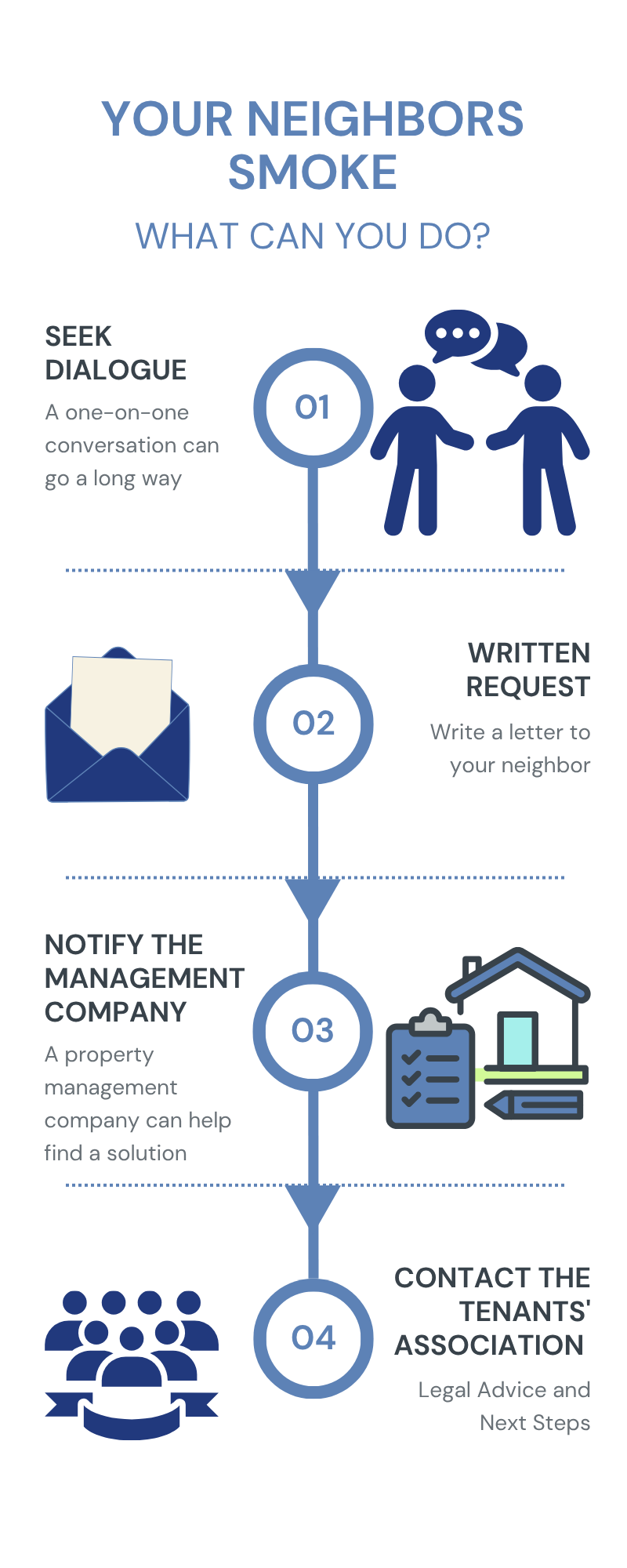
Seek a dialogue with your neighbour
Your neighbour may well be unaware that their smoke is entering your apartment. This conversation is an opportunity to share your concerns and find a solution together.
It is therefore essential to view the other person as a partner in resolving the issue, rather than as an adversary.
Choose a quiet moment.
The conversation
A friendly tone
Start with a sentence that sets a friendly tone: ‘Hello, I wanted to discuss a small issue I’m having; perhaps we could find a solution together.’
Avoid accusations and hostility
Avoid accusations and hostility. Do not use accusatory or hostile language; for instance, instead of saying ‘your smoke is unbearable and it has to stop’, say ‘When I smell smoke in my apartment, I have trouble breathing’, or ‘my children cough.’ In other words, speak about your own experience rather than what the other person is doing “wrong.”
How the smoke gets in
Next, address how the smoke enters your home and what solutions you might find together. For example: ‘I’ve noticed that smoke often comes in through my windows, and it’s causing health issues for me. Could we talk about how to make things more comfortable for all of us?’
Suggest options without imposing them
Change the time the activity takes place. Change the location.
Remain open to dialogue
Listen to the other person as well. Try to find common ground through concrete measures.
If an amicable discussion does not resolve the issue, here are the next steps you can take.
Writing a letter to your neighbour
This step is not mandatory, but putting your request in writing can lend it more weight. Furthermore, if you decide to take further action, a written document will make your initial steps more official. You can find a template letter—which you can adapt as needed—in our template section.
When should you turn to neighbourhood mediation?
Before writing to the landlord, it can be helpful to seek mediation. This voluntary process helps defuse tensions and find balanced solutions with the assistance of a neutral third party.
Why mediation?
It fosters dialogue, preserves the relationship between neighbours, and can prevent a conflict from escalating. Its aim is to avoid the situation getting worse, which is obviously preferable when dealing with neighbourly disputes.
When should it be proposed?
After an initial discussion with the person involved, if the problem persists but dialogue remains possible. The mediator can help both parties explore mutually acceptable compromises without necessarily resorting to formal notices or legal compulsion.
And what if that isn’t enough?
If no solution is found, or if the person refuses to discuss the matter, the landlord can be involved.
Mediation is often free or low-cost. Many municipalities or associations offer this service.
If nothing changes, warn your neighbour that you will report the situation to your landlord.
Important !
People who have experienced this issue often realise, in hindsight, that they should have engaged in further dialogue to avoid proceeding to the next stages. These subsequent steps require time, energy, and potentially money.
We therefore strongly recommend pursuing mediation before moving on to the next phases.
Writing to your landlord
If your attempt to discuss the matter with the smoking neighbour fails, you can inform your landlord of the situation via registered letter. It is advisable to attach a log detailing the times and intensity of the nuisance in order to clearly document the disturbance.
You can find a sample letter to send to your landlord on our “Template Letters” page; simply fill in the details relevant to your situation.
Contact a tenants’ association or your legal protection provider
If the situation does not change, you have two options. You can write to a tenants’ association to inform them of the problem. If you do not contact a tenants’ association, make sure you have legal protection coverage.
Tenants' associations
In Switzerland, these associations play a key role in defending tenants’ rights and often carry more weight than an individual acting alone against a property management company or landlord. Their involvement can facilitate conflict resolution or pave the way for more structured courses of action. You can find the addresses of various tenants’ associations in Switzerland at this link. Membership generally requires an annual fee but provides access to legal advice, personalized support, and sometimes assistance with formal proceedings.
Legal Protection Insurance
If you have legal protection insurance, contact your provider before taking any formal steps. Such policies often cover costs associated with tenancy disputes, including legal advice, the drafting of official letters, formal notices sent to the landlord or property management agency, and even representation during conciliation or court proceedings. They may also fund expert assessments (e.g. air quality measurements or medical certificates). However, most insurers require prior notification before any action is taken in order to cover the costs; therefore, check your policy terms and report the issue promptly to ensure you receive the best possible support.
Other possible sources of assistance
• A law firm specialising in tenancy law.
• A municipal or cantonal service: some municipalities offer free legal consultations for tenants. Check locally.