
Animals: helpless victims of smoke exposure
People often think that secondhand smoke affects only humans, but it can also have serious effects on pets such as dogs, cats, and rodents. Living with us in enclosed spaces, they breathe the same air—and therefore also the harmful substances found in cigarette smoke.
How does secondhand smoke affect our pets?
Just like humans, animals absorb harmful substances—such as nicotine and carcinogens—when exposed to secondhand smoke. Various studies have detected cotinine, a nicotine breakdown product, in the urine, blood, and fur of animals. This demonstrates the extent to which animals can be exposed to smoke.

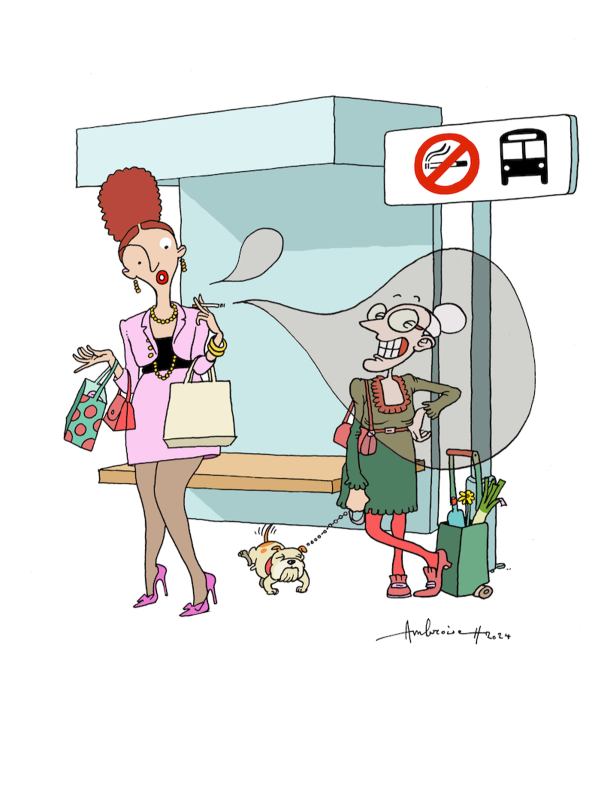
From respiratory distress to cancer—an overview of the risks
This exposure can lead to physical changes and increase the risk of respiratory diseases, inflammation, and even cancer in animals. Several studies have established a link between secondhand smoke and adverse health effects in animals. These include inflammation or cellular changes in the respiratory tract, an increased risk of certain types of cancer, and a weakened immune system, making animals more vulnerable to infections and tumors. Behavioural changes have also been observed: dogs exposed to secondhand smoke have shown increased anxiety and aggression, as well as reduced learning ability.
How to protect your pet from tobacco smoke
Pets rely on us for protection. It is important for smokers to realise that their animals can also suffer the consequences of smoke exposure. A smoke-free home is essential for a healthy living environment—for both humans and animals. Therefore, avoid smoking in enclosed spaces where animals are present. Even good ventilation is not enough; smoke particles settle on furniture, carpets, and fur.
To learn more:
- Bertone, E. R., Snyder, L. A., & Moore, A. S. (2002). Environmental tobacco smoke and risk of malignant lymphoma in pet cats. American Journal of Epidemiology, 156(3), 268-273.https://doi.org/10.1093/aje/kwf044
- Bertone-Johnson, E. R., Procter-Gray, E., Gollenberg, A. L., Bundga, M. E., & Barber, L. G. (2007). Environmental tobacco smoke and canine urinary cotinine level. Environmental Research, 106(3), 361–364. https://doi.org/10.1016/j.envres.2007.09.007
- Johnson, J. D., Houchens, D. P., Kluwe, W. M., Craig, D. K., & Fisher, G. L. (1990). Effects of mainstream and environmental tobacco smoke on the immune system in animals and humans: A review. Critical Reviews in Toxicology, 20(5), 369–395. https://doi.org/10.3109/10408449009089870
- Vasconcelos, T. B. de, Araújo, F. Y. R. de, Pinho, J. P. M. de, Soares, P. M. G., & Bastos, V. P. D. (2016). Effects of passive inhalation of cigarette smoke on structural and functional parameters in the respiratory system of guinea pigs. Jornal Brasileiro de Pneumologia, 42(5), 333–340. https://doi.org/10.1590/S1806-37562015000000342
- Groppetti, D., Pizzi, G., Pecile, A., Bronzo, V., & Mazzola, S. M. (2023). Cotinine as a sentinel of canine exposure to tobacco smoke. Animals, 13(4), 693. https://doi.org/10.3390/ani13040693
- Reif, J. S., Dunn, K., Ogilvie, G. K., & Harris, C. K. (1992). Passive smoking and canine lung cancer risk. American Journal of Epidemiology, 135(3), 234–239. https://doi.org/10.1093/oxfordjournals.aje.a116276
- Alaie, M., Sheikhi Narani, M., Jamshidi, S., Tamimi, N. S. M., & Akbarein, H. (2025). Behavioral changes in domestic dogs associated with exposure to secondhand smoke: A cross-sectional study. Journal of Veterinary Behavior, 79, 53–59. https://doi.org/10.1016/j.jveb.2025.04.008