
Other products
Passive vaping, heated tobacco, and shisha all release harmful substances that can be inhaled by bystanders, even without direct use. Electronic cigarettes emit ultrafine particles and toxic compounds into the surrounding air. As for heated tobacco, it does indeed produce smoke that contains irritants or carcinogens. Shisha also exposes those nearby to dense, hazardous smoke—sometimes in quantities equivalent to a hundred cigarettes in a single session.
Can e-cigarette vapour also be harmful to those nearby?
And what about heated tobacco products, marketed by manufacturers as a “smoke-free alternative”?
And what about shisha?
We will see that all these devices pose health risks to people in the vicinity of users.
The electronic cigarette (also known as e-cigarettes or vapes)
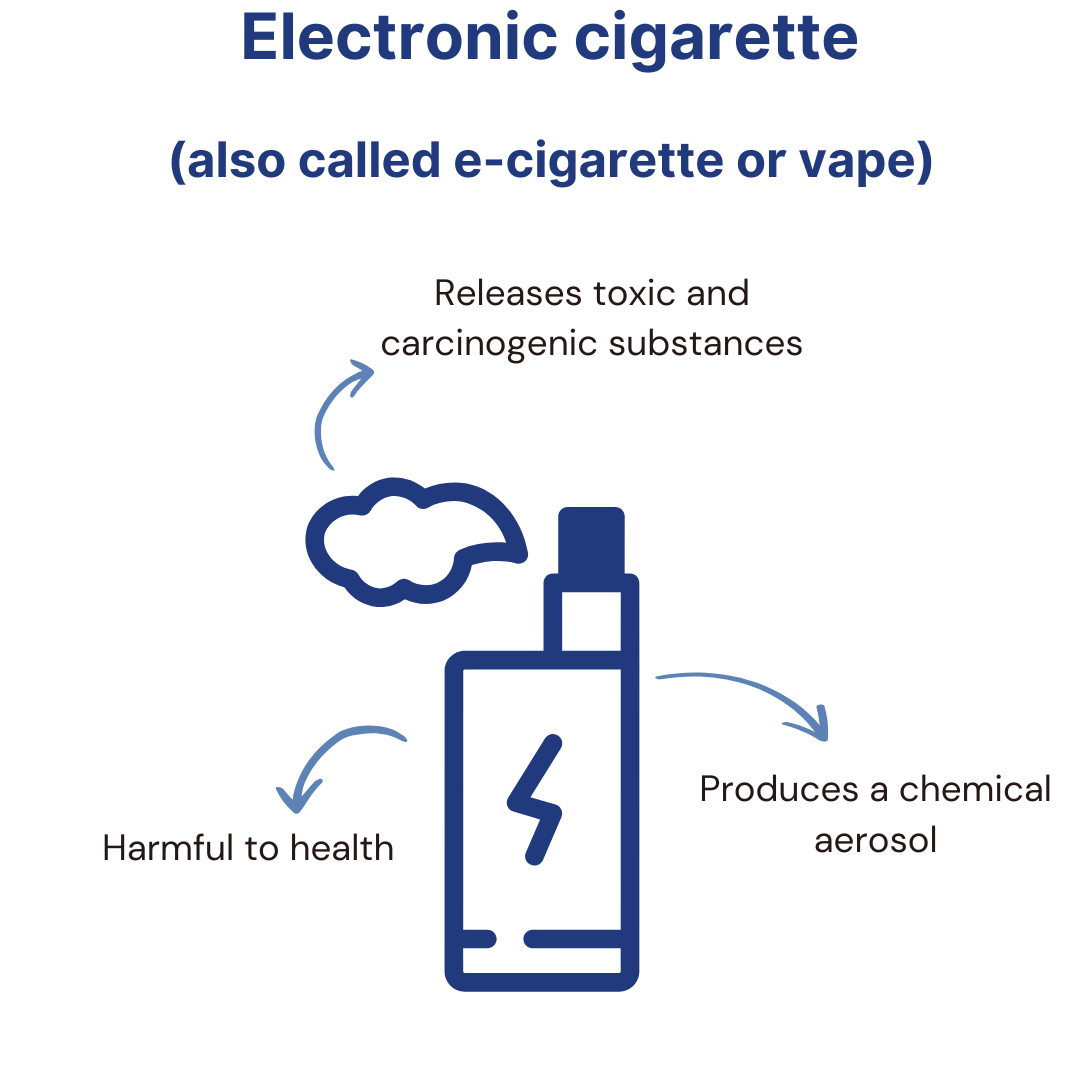
Before discussing secondhand vaping, let’s look at research into the potential dangers of e-cigarette use. We often hear that they are less harmful than conventional cigarettes. A scientific review (Sahu et al., 2023) based on 60 studies shows that e-cigarettes contain several substances known to be toxic or carcinogenic, such as formaldehyde, acrolein, and heavy metals. Long-term studies are still lacking, given that e-cigarettes only appeared in the early 2010s. However, certain biological signs observed in those who vape indicate that the body does indeed react to these substances—sometimes in ways similar to the reactions seen in smokers.
If e-cigarettes can release substances harmful to the user, it follows that these same substances can also be released into the surrounding air—and thus inhaled by bystanders. Electronic cigarettes emit a chemical aerosol, not merely water vapour, as is often mistakenly believed. Referring to it as “vapour” is therefore inaccurate, even though the term is commonly used. Exposure to this aerosol constitutes what is known as passive vaping: the involuntary exposure to the aerosol from an e-cigarette used by someone else.
American researchers (Wei-Chung Su et al., 2021) investigated what a person actually breathes in when exposed to electronic cigarette aerosol. The findings are unequivocal: even without vaping themselves, a person in the same room as a vaper does indeed inhale some of the substances released into the air. And these are not merely trace amounts; certain ultrafine particles—invisible to the naked eye—reach the most delicate area of the lungs directly: the alveoli, where gas exchange with the blood takes place.
That’s why Swiss and European legislation makes no distinction: the law prohibiting smoking in enclosed public spaces also applies to vaping, due to the risks posed to those nearby.
Heated tobacco
In recent years, major tobacco brands have been promoting new so-called “smoke-free” products, such as heated tobacco sticks. The pitch is appealing: no combustion, and therefore fewer toxic substances. These products—such as Philip Morris’s IQOS or BAT’s glo—are marketed as a “cleaner alternative” to conventional cigarettes.
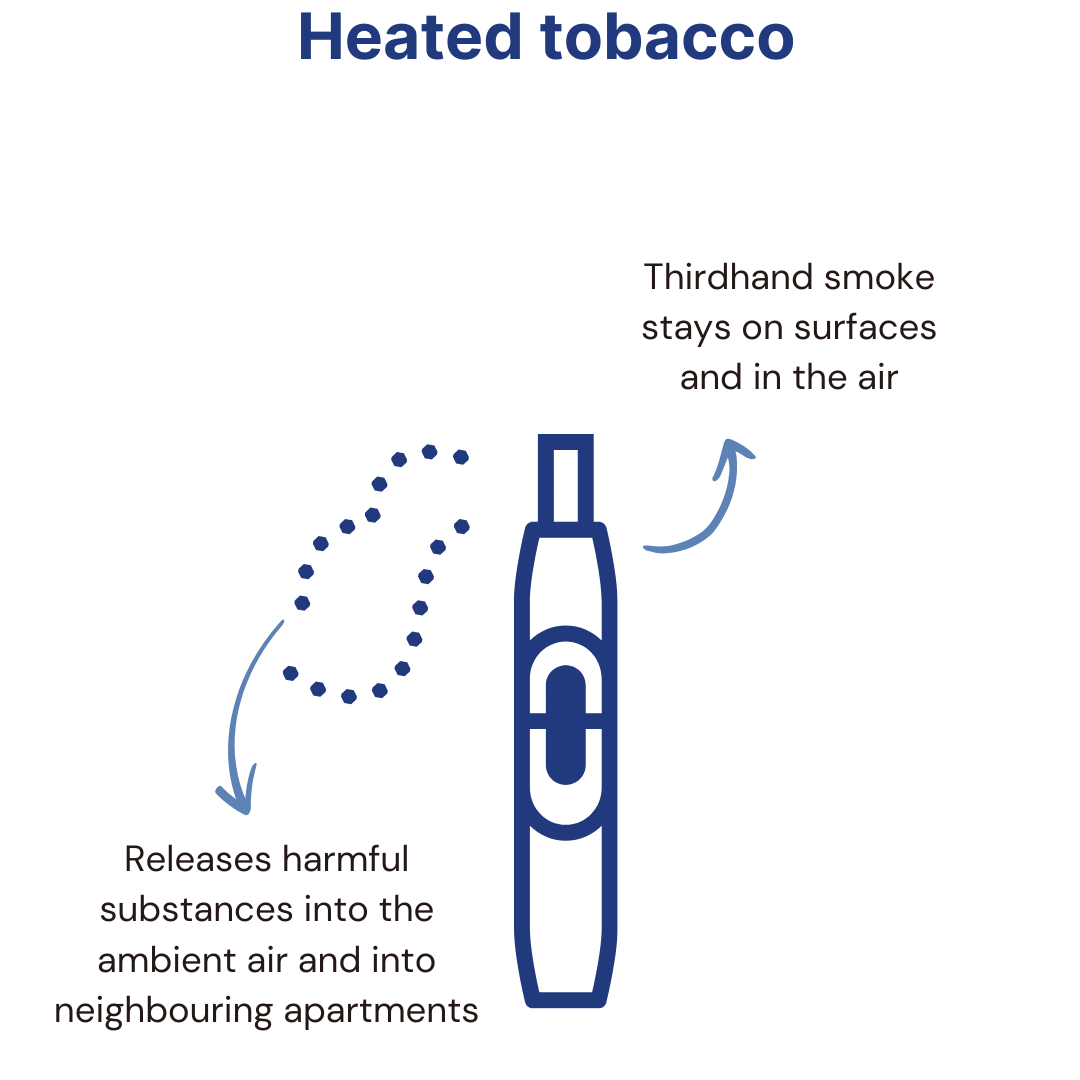
But be warned: what these devices produce is not harmless vapour; it is indeed smoke, in the scientific sense of the term.
Analyses have revealed that heated tobacco products release toxic substances—sometimes in quantities similar to those found in traditional cigarettes—such as nicotine, acrolein, formaldehyde, PAHs (polycyclic aromatic hydrocarbons), and heavy metals (Auer et al., 2017). Many of these substances are irritants, carcinogens, or toxic to the respiratory and cardiovascular systems. Some studies indicate that the biological effects (inflammation, oxidative stress, cellular alteration) may be similar to those observed in smokers.
Thus, what people around an IQOS user inhale is indeed smoke. These emissions can seep into neighbouring homes (through air vents, thin walls, or open windows), remain suspended in the air, or settle on surfaces (known as thirdhand smoke).

Even though the concentrations of toxic substances differ from those found in conventional cigarette smoke, this does not mean they are harmless. On the contrary, children, the elderly, and individuals with chronic illnesses may be particularly sensitive to such exposure, even at low doses.
Shisha (or chicha, hookah, water pipe, narghile)
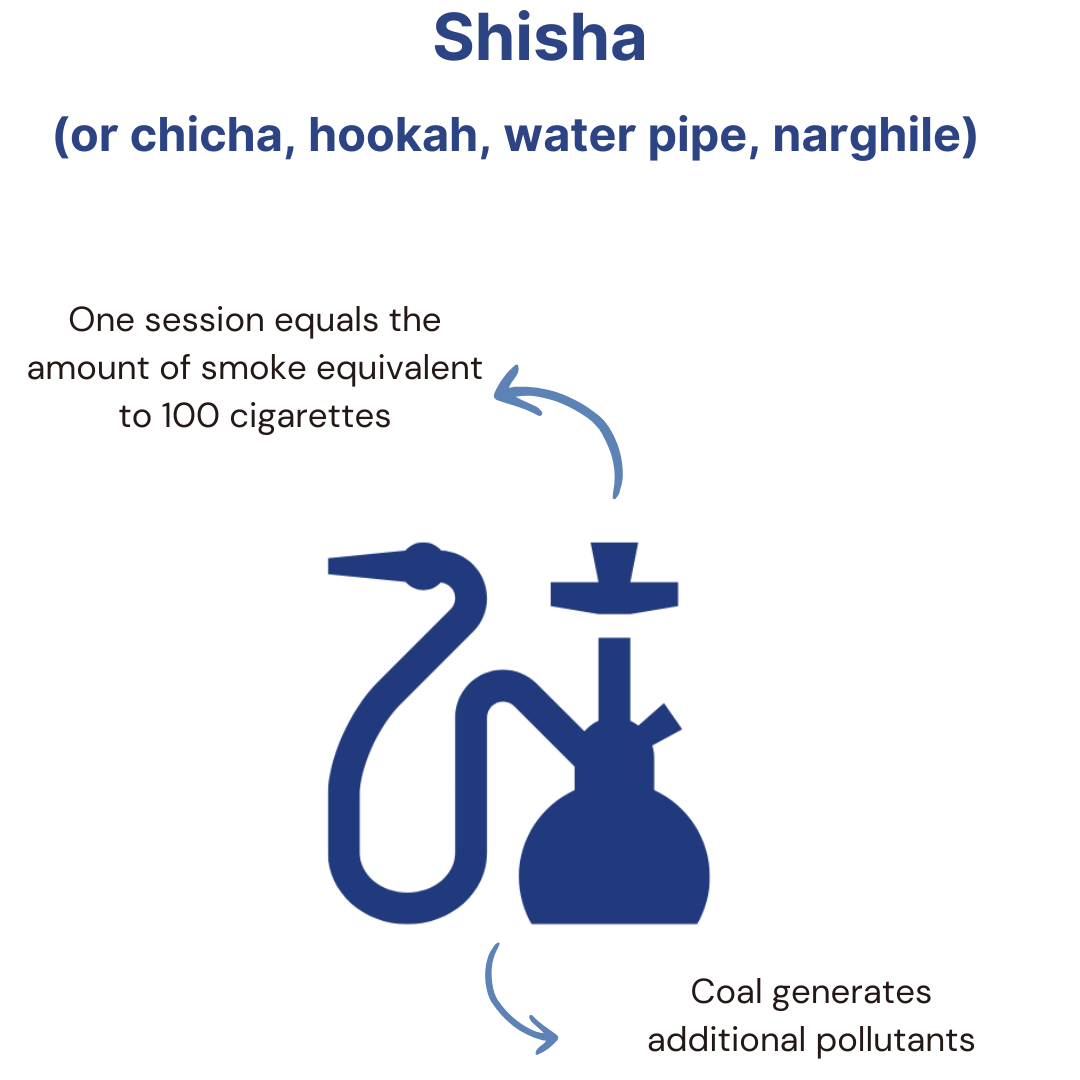
Often perceived as a milder alternative to cigarettes, shisha—also known as hookah—actually exposes smokers and those around them to health risks that are at least equivalent to, if not greater than, those associated with cigarettes. Contrary to popular belief, shisha smoke is not effectively filtered by the water; it contains numerous toxic substances, including carbon monoxide, fine particles, tar, heavy metals, and carcinogenic compounds such as PAHs.
As with other forms of tobacco use, these substances disperse into the surrounding air and can be inhaled by those present, whether or not they are smoking themselves. According to the World Health Organization, a 45-minute shisha session can produce as much smoke as a hundred cigarettes. This means that those nearby—including children or vulnerable individuals—can be exposed to significant concentrations of toxins in a relatively short period.
Smoking hookah is not just a “social activity”—it also exposes everyone nearby to dense, dangerous smoke.
In enclosed or poorly ventilated spaces, hookah smoke can linger in the air and on furnishings for a long time—generating secondhand and thirdhand smoke—thereby increasing respiratory and cardiovascular health risks for those nearby. Some studies also indicate that the burning of the charcoal used to heat the tobacco is a significant source of additional harmful substances.