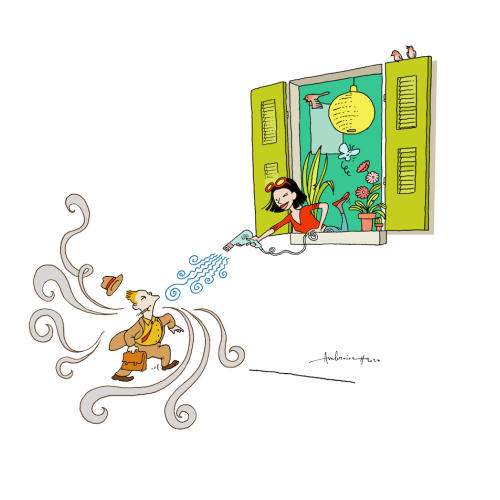
What is passive smoke?
No level of exposure to passive smoke is safe; even small amounts can be harmful to health. Passive smoke—the smoke inhaled by those around the smoker—is more toxic than the smoke the smoker inhales directly. Thirdhand smoke consists of invisible smoke residues that settle on surfaces (such as clothing, furniture, and walls) and linger for months; these residues can accumulate over time.
Children are at the greatest risk: they play on the floor, put objects in their mouths, and breathe more rapidly, all while having an immature immune system.
A 100% smoke-free environment is the only effective form of protection.
Passive smoke : the essentials
Passive smoking is the involuntary inhalation of tobacco smoke present in the environment. It comes from both the smoke exhaled by the smoker and the smoke that escapes directly from the cigarette (sidestream smoke) or other burning tobacco products. This is often referred to as passive smoking, because even non-smokers can suffer the consequences simply by sharing space with a smoker.
It is important to know that no amount of passive smoking is safe. Studies have shown that it contains more than 7,000 chemicals, at least 70 of which are known to be carcinogenic (benzene, formaldehyde, arsenic, etc.).
The health effects are numerous: cancers, cardiovascular diseases, respiratory disorders, upper respiratory tract infections (ears, nose, throat), aggravated asthma, and more… Children, pregnant women, and the elderly are particularly vulnerable.

Passive smoking is not limited to conventional cigarettes. Hookahs, heated tobacco products, e-cigarettes, cannabis, cigars, and pipes also emit substances harmful to humans and pets.
The different forms of secondhand smoke
Secondhand smoke
Secondhand smoke (or ambient tobacco smoke) is the smoke inhaled when in the immediate vicinity of a burning cigarette or a smoker exhaling smoke.
...
This is the most well-known form of passive smoking. This smoke consists of 85% smoke drifting directly from the cigarette and 15% exhaled smoke. It is more toxic than the smoke inhaled by the smoker, as it is less and contains higher levels of fine particles and chemical substances. Studies have shown that the concentrations of certain carcinogens (such as nitrosamines) are higher in secondhand smoke than in directly inhaled smoke.
Within a few minutes in an enclosed space, pollutant concentrations can reach levels higher than those found on a busy highway.
Thirdhand smoke :
an invisible but persistent danger
Thirdhand smoke is less well-known to the general public but poses a real threat. It refers to chemical residues from cigarette smoke that settle on all surfaces—walls, curtains, furniture, clothing, hair, skin, carpets, and so on. These substances can also gradually accumulate over time.
...
These substances cannot be eliminated simply by airing out a room or cleaning. Some can remain active for months or even years, continuing to release toxic particles into the surrounding air—even after any odor has vanished. They can also interact with other compounds present in the environment (such as ozone or ammonia) to form new carcinogenic agents.
- They crawl or play on the floor, in direct contact with contaminated surfaces.
- They frequently put objects in their mouths.
- Their immune systems are still developing.
- They breathe more rapidly than adults, which increases their relative exposure.

Even a room where no one smokes in a child’s presence can pose a danger if smokers have previously used tobacco there.
The only effective means of protection is a 100% tobacco-free environment.
What can be done to protect oneself and others?
- Never smoke indoors, even near an open window.
- Avoid smoking in cars, especially when other passengers are present.
- Regularly clean contaminated surfaces, but be aware that no amount of cleaning replaces a smoke-free environment.
- Inform family and relatives about the dangers of third-hand smoke, particularly for young children.
- Support policies aimed at preventing and combating smoking.
What is the legislation?
Since 2010, the Federal Act on Protection against Passive Smoking has prohibited smoking in enclosed spaces accessible to the public or serving as collective workplaces.